Trading confluences explained in 18 minutes for traders building a repeatable edge
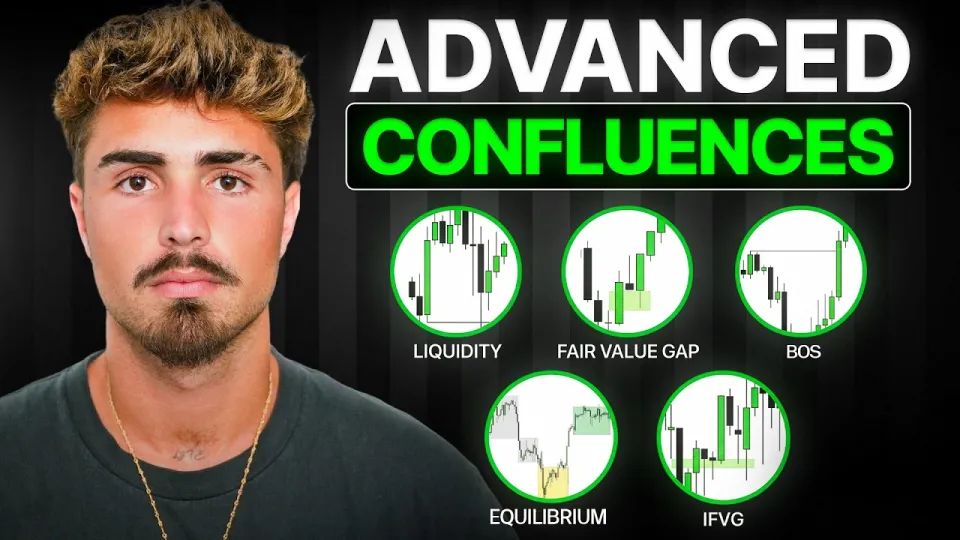
Video: Learn Every Trading Confluence In 18 Minutes
Want articles like this for your own video to promote it on YouTube and Google? Order them through the Telegram bot @sat_sit_bot. The bot writes and publishes the articles itself (with your YouTube video embedded) on popular topical websites (no ads). Free trial — 50 articles.
· based on the channel TJR
Key takeaways
- A confluence is a second, independent reason to take a trade; one signal alone is a guess, two or three aligned signals form a setup.
- The TJR breakdown covers five core concepts: liquidity, fair value gaps, inverse fair value gaps, equal highs and lows, and break of structure.
- Liquidity pools sit above equal highs and below equal lows, where resting stop orders give large players the volume to fill positions.
- A fair value gap is a three-candle imbalance left by a displacement move; price often returns to it before continuing.
- Stacking four or more confluences usually means waiting longer, not trading more; quality of setup beats frequency of trades.
Trading with confluences means waiting for two or more independent signals to point at the same price level before risking capital, instead of acting on a single pattern. In the TJR video Learn Every Trading Confluence In 18 Minutes, the host compresses the core concepts — liquidity, fair value gaps, inverse fair value gaps, equal highs and lows, and break of structure — into one tight walkthrough. The full framework behind that approach is available through the TJR trading blueprint, which is the paid program the channel points viewers to.
What a confluence actually is in trading
A confluence is a second, independent reason to enter a trade at the same place your first signal fired. One pattern on its own is a hypothesis; two or three unrelated tools agreeing on the same level turns it into a setup with a defined invalidation point. The practical value is not that confluences predict the future — they don't — but that they force you to define why a level matters before you click buy or sell, which makes the trade easier to review afterwards.
A simple way to think about it: if your stop loss is hit, which conditions were supposed to hold? Every confluence you list is a condition that must survive for the idea to stay valid. That is why traders who journal their setups tend to describe them as stacks of conditions rather than single triggers.
The five confluences TJR walks through
The video groups the concepts most retail price-action traders use into five building blocks. Each one answers a different question about the chart.
- Liquidity — where are the resting orders? Pools of stop losses and pending orders cluster above equal highs and below equal lows, and large participants need that volume to fill size.
- Fair value gap (FVG) — a three-candle imbalance created by a fast displacement move, where the middle candle's range is not fully traded. Price frequently returns into that gap before continuing.
- Inverse fair value gap (IFVG) — an FVG that failed to hold as support or resistance and now acts in the opposite direction, flipping from demand to supply or the reverse.
- Equal highs and equal lows (EQH/EQL) — two or more swings at nearly the same price, which read as obvious targets and as liquidity magnets.
- Break of structure (BOS) — a close beyond a prior swing high or low that confirms the current leg of the trend and tells you which side of the market you should be trading.
None of these is proprietary. What matters is how they are combined and in what order they are checked.
How to stack confluences into one trade idea
The order of checks matters more than the number of indicators on the chart. A workable sequence looks like this:
- Step 1 — direction. Establish the higher-timeframe bias with break of structure. If price has closed above the last significant swing high, you are looking for longs, not shorts.
- Step 2 — target. Mark equal highs and equal lows, plus obvious session highs and lows. These are the liquidity pools price is likely drawn toward.
- Step 3 — zone. Find the fair value gap or order block that price would have to travel through to reach that liquidity.
- Step 4 — confirmation. Wait for price to react inside the zone, and treat an inverse FVG as a sign the zone has flipped and the idea is invalidated.
- Step 5 — risk. Place the stop beyond the structure that created the setup, and size the position from that distance rather than from a fixed lot size.
When three of these align — say a bullish BOS, an unmitigated FVG below current price, and equal highs above as the draw — you have a tradeable idea. When only one aligns, you have a chart pattern.
Where the confluence approach breaks down
More confluences do not automatically mean a better trade, and this is the most common misunderstanding among newer traders. Adding indicators until a setup looks convincing is a form of confirmation bias, not analysis. Two genuinely independent signals are usually enough; five overlapping ones that all derive from the same price data add nothing but delay.
The second failure mode is context blindness. A fair value gap in the middle of a quiet Asian session on a low-volume pair behaves very differently from the same gap formed during a news release on an index future. Liquidity, spread, and session timing change how reliably any level holds, and the video's concepts assume a market with enough participation to actually fill orders at those levels.
The third is over-trading. Confluence-based systems are selective by design, so the honest outcome of stricter rules is fewer trades, not more. Traders who feel they must be in the market every session usually loosen their criteria until the edge disappears.
Common questions traders raise about confluence setups
Viewers of the breakdown tend to raise the same practical doubts. The most frequent is which confluences are worth keeping: the honest answer is that value is strategy-specific, so the test is whether removing a confluence changes your results over a sample of at least 50 trades. If it doesn't, it is decoration.
Another recurring theme is the emotional side. Several commenters describe the learning curve as something you have to go through yourself, losing money along the way, and warn that social media highlights only the winning side of trading. That is consistent with the disclaimers in the video description: day trading is risky and most day traders lose money. Treat any claim of fast account growth, including screenshots posted in comment sections, as unverified.
A third concern is discipline and risk-reward. It is worth building a written checklist — bias, liquidity target, zone, confirmation, stop, size — and grading every trade against it, because the checklist is what makes confluences repeatable rather than improvised.
Useful links from the video
- TJR trading blueprint — the full system for becoming a consistently profitable trader
- Indicators TJR uses daily
- Funded account raffle entry
- Alpha Futures signup with 10% off
- Lucid Trading with 40% off
Bottom line on learning confluences
The 18-minute format works because it treats confluences as a checklist rather than a secret: liquidity tells you where price is drawn, fair value gaps and inverse FVGs tell you where the reaction may happen, equal highs and lows mark the targets, and break of structure sets the direction. Build the checklist, backtest it, and grade every trade against it before adding anything new. The TJR channel is the source of this condensed breakdown, and the blueprint program is where the channel takes traders who want the complete process. Keep position size small while the checklist is still unproven, and remember that no confluence removes the risk of loss.
Questions & answers
How many confluences should a trade have?
Most traders find two or three independent confluences sufficient: a directional signal such as break of structure, a zone such as a fair value gap, and a liquidity target. Adding more rarely improves results unless each addition is tested separately over a meaningful sample of trades.
What is the difference between a fair value gap and an inverse fair value gap?
A fair value gap is a three-candle imbalance left by a displacement move that price may return to. An inverse fair value gap is the same zone after it has failed to hold — it then acts in the opposite direction, flipping from support to resistance or vice versa, and often signals that the original idea is invalid.
Do confluences work on any timeframe or market?
The concepts are timeframe-agnostic, but reliability depends on participation. Levels built on equal highs and lows matter more when there is enough volume to fill orders there, so major sessions and liquid instruments such as index futures or large-cap pairs behave more predictably than thin markets.
Can I become profitable just by learning these confluences?
No single concept guarantees profitability, and the video's own disclaimer states that day trading is risky and most day traders lose money. Confluences help structure decisions and define risk, but results depend on execution, position sizing, and the discipline to skip setups that do not meet your criteria.
Source: Learn Every Trading Confluence In 18 Minutes · Markdown version